The best event venue in Dubai or Abu Dhabi is the one that fits your event’s purpose, guest count, technical needs and season. Luxury hotels suit weddings, galas and corporate dinners. Standalone event spaces suit launches and brand activations that need design freedom. Exhibition halls and conference centres handle large-scale conferences and trade shows. Outdoor venues deliver atmosphere, but mostly between October and April. This guide covers all four categories, with capacity ranges, cost drivers and logistics lessons from our work as an event management company based in Dubai.
Understanding Your Venue Needs: Event Type, Guest Count & Location Strategy

Most venue searches start with a shortlist of famous names. We start with four questions instead. We call this the Four-Lens Venue Test: Purpose, People, Place and Production. A venue has to pass all four lenses, and a striking room that fails one usually becomes an expensive compromise.
- Purpose: What must the event achieve? A product launch needs a reveal moment and strong content capture. A conference needs sightlines, acoustics and breakout rooms. A wedding needs emotion, privacy and flow between ceremony, dinner and celebration.
- People: How many guests will actually attend, and who are they? Confirmed numbers, VIP profiles, international travellers, accessibility requirements and cultural considerations all shape the choice.
- Place: Where do guests start and finish their journey? Dubai and Abu Dhabi are roughly 90 minutes apart by road, so a venue’s location affects attendance as much as its design does.
- Production: What does the build require? Power, rigging points, loading access, ceiling height, internet capacity and the time available for setup and breakdown all matter.
On location strategy, Dubai offers the greater density of options, clustered around Downtown, Dubai Marina, Palm Jumeirah, Business Bay, Dubai Design District and Expo City. Abu Dhabi tends toward fewer but larger and more monumental settings, across the Corniche, Saadiyat Island, Yas Island and the ADNEC district. Dubai suits events that want choice and energy. Abu Dhabi suits events that want scale, calm and cultural gravitas.
Luxury Hotel Venues in Dubai & Abu Dhabi: Capacity, Settings & Why They Matter
Hotels are the most common choice for corporate event spaces and luxury ballrooms in the UAE, and for good reason. They bundle the room, catering, accommodation, service staff, licensing and often technical support under one roof. For international delegations or guests travelling from abroad, that convenience is hard to match.
Typical hotel capacity ranges (always confirm against your own layout, because theatre, banquet and reception capacities differ widely):
- Boardrooms and private dining rooms: 10 to 60 guests
- Mid-size ballrooms and function rooms: 100 to 400 guests
- Grand ballrooms: roughly 500 to 1,500 guests, with a few of the largest exceeding that in reception format
- Combined ballroom, foyer and terrace footprints: larger still, with the right zoning
In Dubai, resort and city hotels along the Palm, Marina and Downtown corridors give you waterfront terraces, skyline backdrops and strong event venues Dubai hotels can use for multi-day programmes. Properties such as Atlantis The Palm and Madinat Jumeirah are known for large-format capability. Abu Dhabi’s grand hotels, including Emirates Palace Mandarin Oriental and the Saadiyat and Yas Island resorts, lean toward heritage-scale architecture and spacious grounds. Wedding venues in Dubai tend to offer more variety of style, from rooftop to beachfront, while Abu Dhabi’s ballrooms often impress through sheer volume and ceiling height.
Why hotels matter beyond convenience: they come with licensed food and beverage operations, established security protocols and experienced banqueting teams. The trade-off is flexibility. In-house catering is often mandatory, décor rules can restrict what you build, and the room may be shared with other bookings on the same property. Check that early.
Standalone Event Spaces & Ballrooms: Flexibility, Design Freedom & Customization
Standalone event spaces in the UAE include converted warehouses, gallery spaces, cultural venues, beach clubs, opera houses and purpose-built event halls. Their defining advantage is the blank canvas. Where a hotel gives you a finished interior, a standalone space lets you transform the environment entirely, which is why they are popular for product launch venues in Dubai, fashion presentations and luxury brand activations.
Examples of the category include Dubai Opera, with roughly 2,000 seats in its theatre configuration and a convertible format for gala dinners, creative districts such as Dubai Design District, and Abu Dhabi’s cultural settings around Saadiyat Island. Etihad Arena on Yas Island serves a much larger scale, with concert configurations of up to around 18,000 guests.
What to evaluate in a standalone venue:
- Infrastructure you will need to bring in. Power distribution, air conditioning capacity, toilets, kitchens, security and signage may all be supplied externally.
- Preferred supplier lists. Many venues restrict caterers, AV providers or contractors, which affects your design and budget planning.
- Permits and licensing. Alcohol, live music, filming and structures typically require approval from the relevant authority, such as Dubai’s Department of Economy and Tourism or Abu Dhabi’s Department of Culture and Tourism.
- Build and strike windows. A transformation is only as good as the time available to complete it.
The most common mistake we see is underestimating the production layer. A raw space looks inexpensive on paper, but the work of making it guest-ready is real. It is also where creative direction can make an event unforgettable, so the investment is rarely wasted when it is planned properly.
Exhibition Halls & Conference Centers: Large-Scale Events, Technical Requirements & Infrastructure
When an event runs into the thousands of attendees, or needs booths, stages and multiple parallel sessions, purpose-built exhibition halls are the practical choice. In Dubai, exhibition halls include Dubai World Trade Centre and the Dubai Exhibition Centre at Expo City Dubai. In Abu Dhabi, the Abu Dhabi National Exhibition Centre (ADNEC) is among the region’s largest, and Abu Dhabi conference centres in the same district support delegations, summits and trade shows with integrated hotels nearby.
What these venues offer that other categories rarely match:
- Column-free halls with high ceilings for large stand construction and rigging
- Heavy-duty loading bays, freight access and floor loading capacity
- Dedicated power, water, data and compressed air connections at floor level
- Registration areas, meeting rooms, press centres and catering zones designed for volume
- Established crowd management, parking and security systems
Technical requirements to confirm in writing: power available per stand or per zone, internet bandwidth and whether it is shared, ceiling height and rigging weight limits, floor load limits, exhibitor build regulations, approved contractor rules, and hall handover and dismantle times. Exhibition venues often have strict stand construction regulations, which shape booth design from the first sketch. For brands exhibiting, innovative booth design and construction is as much about compliance and efficient installation as it is about creativity. If exhibiting is your focus, our related guide to the best exhibition centres in the UAE goes deeper, and our comparison of tech-ready conference venues in Dubai covers the AV and connectivity side in more detail.
Outdoor Venues in Dubai & Abu Dhabi: Beachfront, Desert & Garden Settings
Outdoor event venues in Abu Dhabi and Dubai provide settings that indoor rooms cannot replicate: the Gulf at sunset, desert dunes under open sky, landscaped gardens and waterfront promenades. Beachfront venues suit weddings, receptions and brand experiences. Desert camps and dune settings suit incentive programmes and cultural evenings. Gardens, rooftops and resort lawns suit cocktail receptions and ceremonies.
Are outdoor venues viable year-round in Dubai and Abu Dhabi?
Not equally. Outdoor events are most comfortable from roughly October to April, when daytime temperatures are mild and evenings are pleasant. From June to September, temperatures commonly exceed 40°C with high humidity, and an unshaded outdoor event is not realistic for most guests. Summer outdoor events can work, but only with a specific design response:
- Start after sunset and plan arrival in air-conditioned areas
- Use shaded, misted or cooled structures, and have an indoor fallback
- Keep guest exposure short, with minimal walking distances
- Protect sensitive equipment, florals and food from heat
Wind, sand, and occasional winter rain are also factors. Beach and desert venues may need ground protection, windproof structures and generator planning. We always recommend a weather contingency plan, not just a backup room, because a backup that cannot hold your guest count is not a backup.
Venue Selection by Event Type: Corporate Conferences, Weddings, Product Launches & Galas
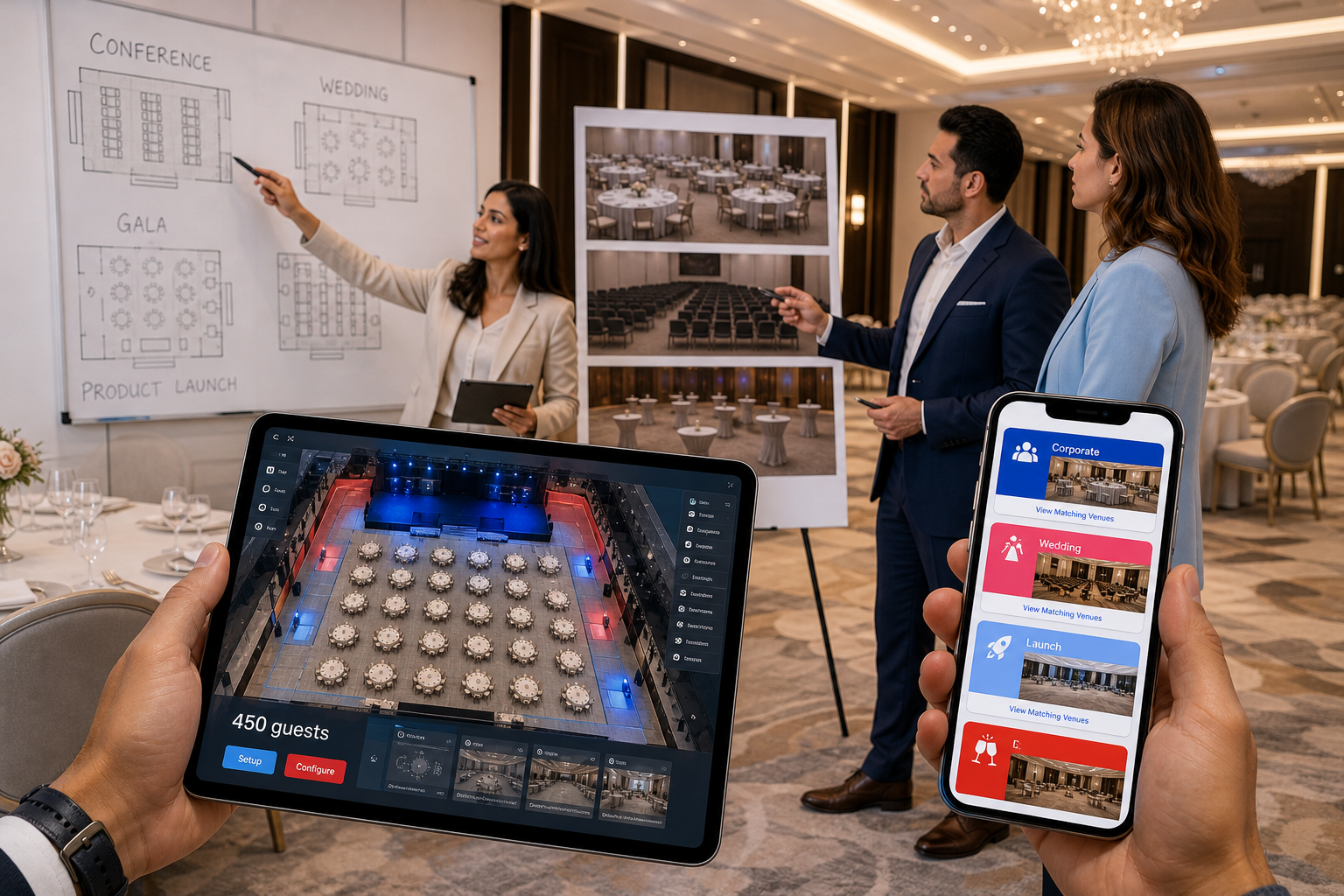
This is where the question “which venue type is best for my event?” gets a practical answer. Here is how we rank the options by event type.
Corporate conferences
Best fit: conference centres and hotel ballrooms with breakout rooms. Prioritise acoustics, sightlines, Wi-Fi capacity, stage and screen options, and proximity to accommodation. For multi-day delegate programmes, a hotel with integrated meeting space reduces transfers. For larger summits, a dedicated conference centre or exhibition hall adds capacity and technical depth. If your event is smaller, our comparison of business meeting and conference venues in Dubai covers space and rates in detail.
Weddings
When people search for wedding venues in Dubai, capacity is usually the first filter. As a rough guide, intimate weddings run from 50 to 150 guests, mid-size celebrations from 150 to 400, and grand celebrations from 500 and up, which is where the largest hotel ballrooms and select standalone venues come into play. Best fit: luxury hotels and beachfront resorts for all-in-one convenience, with standalone and outdoor venues for couples who want a distinctive setting. Look carefully at ceremony-to-reception transitions, bridal suite access, photography locations and the policy on external décor and caterers.
Product launches
Best fit: standalone spaces, design districts, rooftops, and hotels with versatile pre-function areas. A launch needs theatrical control: blackout capability, rigging, content walls, and a journey that builds toward the reveal. Venue prestige matters less than how much of the room you can reshape.
Galas and award nights
Best fit: grand hotel ballrooms, opera and cultural venues, and select outdoor settings in the cooler months. Look at stage size, backstage space, banquet capacity, red-carpet arrival potential and guest flow through the evening.
Essential Logistics & Planning Considerations: From Accessibility to Catering & Technology
A great venue can still fail on logistics. These are the factors we check on every project, in roughly the order they cause problems.
- Accessibility and arrival. Step-free routes, accessible toilets, drop-off zones, valet capacity and parking. Dubai traffic at peak hours and road closures around major events can easily delay arrivals by 30 minutes or more.
- Load-in and load-out. Service lift dimensions, loading dock access, trolley routes, vehicle height limits and time restrictions. Many hotels limit heavy deliveries to overnight hours.
- Catering. In-house only, preferred list or open? Kitchen capacity for your guest count, halal requirements, dietary variety, and alcohol licensing, which is generally tied to licensed hotel and venue premises.
- Technology. Dedicated bandwidth for streaming or registration, AV in-house or external, power capacity, backup generators, and hybrid event capability.
- Permits and compliance. Event approvals, branding and signage rules, music and entertainment licences, filming permissions, and safety certifications for temporary structures.
- Calendar. Ramadan, Eid, school holidays, large exhibitions and the winter peak season (roughly November to March) all affect availability, accommodation and supplier capacity. Book further ahead for those windows.
- Safety and security. Crowd flow, emergency exits, VIP protocols and security screening.
Complex events involve many moving parts, and each one interacts with the others. A venue’s rules on catering, for example, may change your décor plan and your timeline. This is why we treat venue selection as the start of production planning, not a separate step.
Comparing Venues: Capacity, Cost Structure, Amenities & Hidden Factors That Matter
An event venue comparison in the UAE is easiest when the categories sit side by side. The table below summarises typical characteristics. Capacities are indicative planning ranges and vary by layout.
| Venue type | Indicative capacity | Best suited to | Main strengths | Watch for |
|---|---|---|---|---|
| Luxury hotel ballrooms and meeting spaces | Roughly 50 to 2,000+ guests | Galas, weddings, corporate dinners, press conferences | In-house catering, licensing, accommodation, polished finish | Exclusive caterer rules, décor restrictions, fixed load-in windows |
| Standalone event spaces and ballrooms | Roughly 50 to 1,500 guests | Product launches, brand activations, fashion shows, private events | Design freedom, flexible layouts, distinctive character | Outside suppliers needed, licensing responsibility, fewer built-in facilities |
| Exhibition halls and conference centres | Hundreds to tens of thousands | Trade shows, large conferences, sporting and consumer events | Scale, power and rigging, loading access, on-site infrastructure | Contractor and organiser regulations, build and dismantle schedules |
| Outdoor venues (beachfront, desert, garden) | Roughly 30 to 5,000+ guests, depending on site and permits | Weddings, brand experiences, incentive events, cultural evenings | Atmosphere, scenery, memorable photography | Heat and humidity, wind, temporary power, permits, guest transport |
What Should You Compare Beyond Capacity and Price?
Capacity tells you whether a venue can hold your guests. It rarely tells you whether the venue can hold your event. In our experience, the factors that decide whether an event runs smoothly are usually the ones missing from the first brochure. These are the ones we check on every project.
- Usable capacity, not headline capacity. A ballroom rated for 800 guests in theatre style may seat 500 at rounds once you add a stage, a buffet line and a dance floor. Ask for floor plans at your actual layout.
- What the fee structure includes. Hire fees, food and beverage minimums, service charges, security, cleaning, power, rigging and overtime are often itemised separately. Compare what each venue includes, not only the headline figure, so you understand the full scope of the arrangement.
- Load-in and load-out access. Ceiling height, lift size, dock access and permitted hours decide how ambitious your staging and booth construction can be.
- Exclusivity of suppliers. Many venues require their own caterer, AV team or décor partner. This shapes creative options and budget structure alike.
- Timeline for setup and rehearsal. A venue available for four hours before doors open is a very different proposition from one that offers a full day of preparation.
- Surrounding conditions. Parking, valet capacity, road closures during major city events, and the season all shape the guest experience before anyone enters the room.
- Acoustics and sightlines. Pillars, low ceilings and reflective surfaces affect speeches, live performance and screen visibility in ways a photograph does not reveal.
Most venue advice ranks options by prestige or size. We think that gets the order wrong. A venue is well chosen when its constraints are compatible with your creative intent, and a modest space with the right infrastructure will outperform a landmark that fights your programme.
How to Shortlist & Evaluate: Questions to Ask, Site Visits & Red Flags
To shortlist event venues in Dubai or Abu Dhabi, define your non-negotiables, request detailed proposals from three to five venues, visit the strongest candidates at the same time of day as your event, and compare them against a consistent checklist. We use a simple three-part test we call Fit, Flow and Feasibility.
- Fit. Does the venue suit the purpose, audience and tone of the event? This covers capacity at your layout, atmosphere, brand alignment and the impression guests form on arrival.
- Flow. Can people, equipment and service move through the space without friction? This covers guest arrival, registration, circulation, backstage access, catering routes and load-in.
- Feasibility. Can the event legally and practically happen there on your dates? This covers permits, licensing, supplier rules, power, connectivity and the calendar.
A venue that scores well on only one or two of these will usually create problems later. The third is the one most often skipped, because it is the least visible during a tour.
Questions to ask every venue
- What is the maximum capacity for our specific layout, and can we see the floor plan?
- Which services, suppliers and fees are included, and which are optional?
- What are the load-in, setup, rehearsal and breakdown windows?
- Are there restrictions on décor, rigging, branding, sound levels or finish times?
- What are the power, bandwidth and AV capabilities, and is there backup power?
- Which permits and licences do you handle, and which are our responsibility?
- What are the cancellation, rescheduling and payment terms?
- Can you share references from comparable events held here?
What to look for on a site visit
Visit when the space is in use or at the hour your event will take place. Walk the guest journey from the car park or drop-off point to your seat. Then walk the service journey from the loading area to the stage. Check the temperature, the sound from adjacent rooms, the lighting and the signal strength on your phone. For outdoor venues, look at shade, ground surface, wind exposure and where generators and kitchens would sit. Bring your production team, because they will notice constraints that a first-time visitor will not.
Red flags worth taking seriously
- Reluctance to share floor plans, technical specifications or fee breakdowns.
- Vague answers about permits, licensing or who is responsible for them.
- Last-minute changes to terms after a verbal agreement.
- No clear contact for event-day operations.
- Restrictions that surface only late in the process, such as supplier exclusivity or sound limits.
- Little or no experience with events of your size or type.
None of these is automatically a reason to walk away, but each deserves a clear written answer before you commit. Putting agreed details into the contract protects both the venue and the client, and it is a step we never skip.
Related reading: Planning a Luxury Gala Dinner in Dubai · How to Plan a Multi Venue Conference in Dubai
Frequently asked questions
What is the best type of venue for a large corporate event in Dubai?
For large corporate events, hotel ballrooms suit gala dinners and award evenings, while exhibition halls and conference centres suit multi-day conferences and shows that need heavy infrastructure. The right choice depends on guest count, technical requirements and programme format.
How far in advance should I book a venue in Dubai or Abu Dhabi?
For major events, book six to twelve months ahead, and earlier for the winter peak from November to March or around Ramadan and Eid. Smaller private events can sometimes be arranged in a few months, but choice narrows quickly in busy periods.
Are outdoor venues practical in the UAE climate?
Yes, with planning. Outdoor events work best between roughly November and March, when temperatures are comfortable. In summer, evening timings, shade, cooling and indoor backup spaces become essential.
Do I need permits to host an event in a UAE venue?
Often, yes. Requirements vary by emirate, venue and event type, and may cover entertainment, music, filming, signage and temporary structures. Many venues handle some approvals, but you should confirm in writing who is responsible for each one.
Is it better to choose a hotel or a standalone venue?
Choose a hotel when you want integrated catering, licensing, accommodation and a polished setting. Choose a standalone space when you want more design freedom and a distinctive identity, and are prepared to coordinate more suppliers.
Can an event planner help with venue selection?
Yes. A planner can match venues to your creative and technical needs, review contracts and floor plans, coordinate permits and suppliers, and manage the build and event day so the venue works with your vision rather than against it.