An augmented reality event brand activation overlays digital content—such as 3D visual effects, interactive product demos, or gamified challenges—onto the physical environment through smartphones, tablets, or AR smart glasses. Unlike fully virtual environments, an AR event activation enhances the real-world venue, allowing attendees to interact with digital elements seamlessly while standing in your booth or venue space. By bridging the digital and physical worlds, brands increase dwell time, captivate audiences, and drive measurable lead generation.
What Is Augmented Reality in Event Brand Activations?
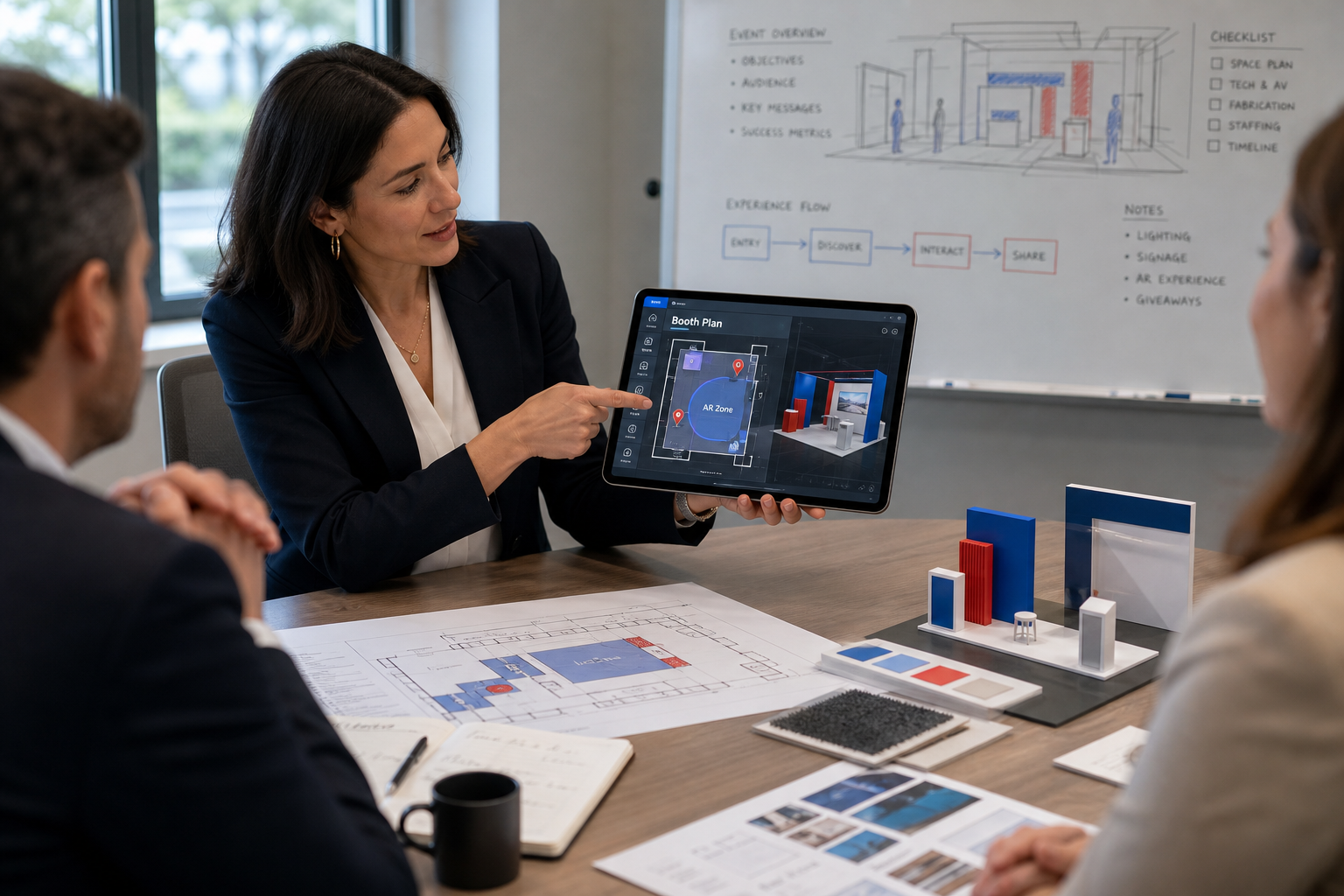
Augmented reality in event brand activations blends real-world event spaces with interactive digital elements. On-site, guests typically access these experiences by scanning QR codes on exhibition walls, stepping in front of digital mirrors, or pointing their mobile devices at specific image targets, physical products, or spatial markers within a booth.
Unlike Virtual Reality (VR), which isolates the user in a completely digital environment, AR layers digital information directly over the attendee’s physical surroundings. This keeps the experience inherently social and contextual. From revealing hidden product features in 3D space to projecting interactive digital avatars, AR turns passive spectators into active participants. To learn more about how extended reality is transforming the industry, explore our guide on AR & VR at events: the future of engagement.
Why AR Works for Live Events, Exhibitions, and Brand Experiences
In high-density event environments like trade shows and international exhibitions, capturing and holding attendee attention is a constant challenge. Traditional static displays often fail to cut through the noise. AR works because it introduces an element of mystery, interactivity, and spatial play that naturally draws a crowd.
By transforming passive observation into an active digital brand experience, AR drives several critical metrics:
- Increased Dwell Time: Gamified and exploratory AR mechanics encourage visitors to spend significantly more time at your booth.
- Higher Message Retention: Interactive, multi-sensory experiences help attendees retain product details far better than traditional print collateral or standard video screens.
- Foot Traffic Multiplication: Visual AR setups create a natural spectacle on the exhibition floor, enticing surrounding attendees to see what others are interacting with.
Key AR Features for Events: Virtual Try-Ons, Interactive Games, and Wayfinding
When selecting immersive event technology for your activation, choice of features should be driven by audience goals and event footprint. The most effective AR activations combine intuitive mechanics with clear value for the guest.
Virtual Try-On Experiences
Ideal for luxury, fashion, cosmetics, and automotive brands, a virtual try-on experience allows guests to preview products instantaneously. Smart AR mirrors and mobile scanners allow users to customize luxury accessories, visualize makeup styles, or adjust color options on life-sized vehicle renders with absolute precision.
Interactive Booth Games and Gamification
Event gamification introduces friendly competition to the show floor. Using web-based AR (WebAR)—which requires no app download—attendees can participate in scavenger hunts around your booth, unlock hidden digital rewards, or play branded mini-games that highlight key product features.
AR Spatial Wayfinding and Information Hotspots
For large-scale corporate conferences and exhibitions, AR wayfinding guides visitors seamlessly through expansive venues. Pointing a camera down an aisle displays digital directional markers, schedule updates, and interactive info-nodes anchored directly to specific booth structures.
How to Blend AR With Physical Event Design for a Seamless Guest Journey
What most advice gets wrong about AR events is treating technology as an afterthought—an isolated digital layer slapped onto a standard physical layout. True immersion requires seamless spatial design where digital assets and physical structures amplify one another.
To design an optimal guest journey, we utilize our spatial integration framework:
- The Physical Anchor: Ensure your physical architecture—such as custom exhibition walls, podiums, or sculptural elements—includes clean, high-contrast tracking targets that mobile sensors can detect effortlessly under venue lighting.
- Dedicated Spatial Zones: Designate clear visual staging areas with adequate space for guests to move, gesture, and view 3D assets without obstructing main foot-traffic corridors.
- Network Redundancy: Never rely solely on venue Wi-Fi. Deploy dedicated on-site edge servers or local Wi-Fi networks so AR rendering remains instant and latency-free.
- Staff Integration: Train booth personnel to act as experience facilitators, guiding guests into the activation smoothly rather than leaving them to figure out technical mechanics on their own.
Social Media Integration: Turning AR Moments Into Shareable Content
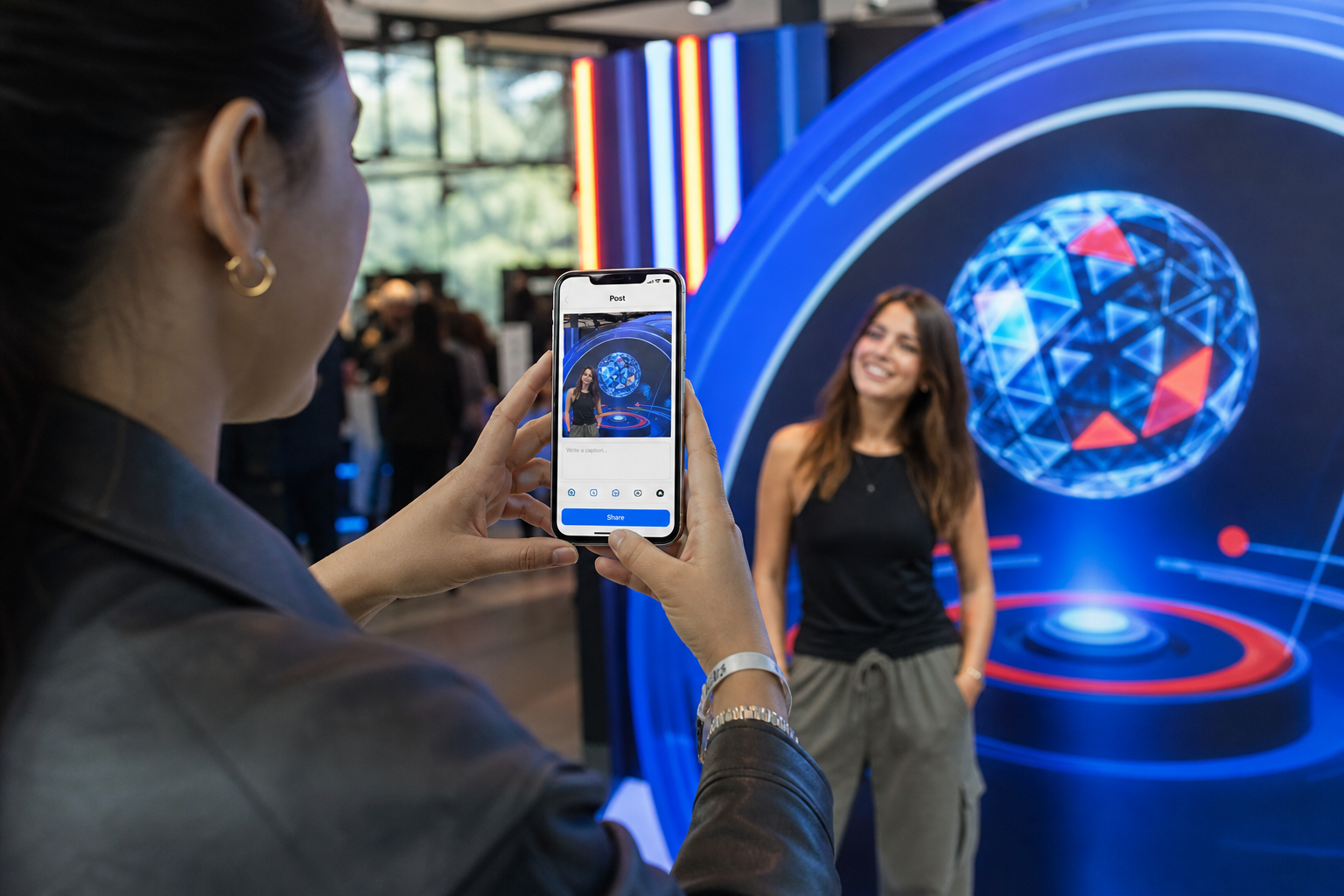
An exceptional on-site activation should resonate far beyond the physical room. By integrating custom social media AR filters directly into your event flow, you empower guests to become broadcast partners for your brand.
Creating branded camera effects for platforms like Instagram, TikTok, or Snapchat allows users to capture photo and video memories wrapped in your event’s digital aesthetic. Incorporating dynamic event hashtags, instant QR code generation for digital takeaways, and automated photo-booth sharing mechanics turns every participant’s personal network into an extension of your campaign reach.
Data Capture and Lead Generation: What to Measure and How to Use It
Beyond engagement, AR provides unparalleled analytical depth. Unlike physical brochures, digital interactions allow you to track real-time behavior and quantify user interest with precision.
Key metrics for event lead capture and performance measurement include:
- Activation Rate: The percentage of total booth visitors who initiate the AR experience.
- Average Engagement Duration: The exact time spent interacting with specific 3D models or game mechanics.
- Feature Preference Metrics: Tracking which product configurations, colors, or information nodes were explored most frequently.
- Direct Conversion Rate: The volume of contact details captured through gated AR rewards, digital brochures, or post-experience follow-up forms.
By connecting WebAR analytics directly to your CRM system, your sales team receives immediate visibility into exactly which features caught a lead’s interest on the show floor.
Real-World Examples of Augmented Reality Event Activations
Across diverse sectors, brands are taking advantage of mixed reality events to solve complex showcase challenges:
Automotive Launch: A premium vehicle manufacturer showcased an engine concept without shipping bulky machinery. Using AR tablets anchored to a physical chassis, attendees explored holographic X-ray views of internal engineering components in real time.
Luxury Retail Activation: A high-end fragrance brand built an interactive booth design where scanning physical botanical displays triggered floating floral animations and personalized scent profile recommendations, boosting both social shares and immediate product sampling.
Industrial Tech Exhibition: A heavy equipment supplier used spatial WebAR to project full-scale, animated machinery models directly onto an empty stage, allowing prospective clients to walk around and inspect functional parts at 1:1 scale without logistical expense.
Celestine’s Approach: From Concept to Execution With Precision
At Celestine Event, we believe technology should serve story and emotion. From concept to execution, we combine creative vision, meticulous attention to detail, and advanced technology to transform every occasion into a masterpiece.
As a full-service event management company headquartered in Dubai, we design custom corporate environments, press conferences, and exhibition booths that integrate AR flawlessly into physical architecture. We handle spatial planning, structural construction, technical deployment, and on-site management with precision techniques to deliver unforgettable experiences that captivate your audience.
Related reading: Exhibition Booth Design and Trade Show Dubai · Trends in Trade Show Design and Engagement for Dubai Markets · Seamless Corporate Events: Design That Delivers
Frequently asked questions
What types of events work best for augmented reality activations?
Augmented reality works especially well at trade shows, exhibitions, product launches, corporate conferences, and brand experiences where attention is hard to win. It is particularly effective in busy environments because it creates a visual and interactive moment that draws people in and gives them a reason to stay longer.
Do guests need to download an app to experience AR at an event?
Not always. Many event activations use WebAR, which runs through a mobile browser and does not require a separate app download. This makes the experience easier to access on-site and reduces friction for guests, especially in fast-moving exhibition environments where convenience matters.
Can AR be used for product launches and demonstrations?
Yes. AR is well suited to product launches because it can reveal product features, show 3D models, or let guests explore variations without needing physical inventory. It can help brands present complex products in a more engaging way while keeping the experience interactive and memorable.
How does augmented reality support social media marketing at events?
AR can be designed to generate shareable moments through branded filters, interactive visuals, and photo or video effects. When guests enjoy the experience, they are more likely to share it online, which extends the campaign beyond the venue and turns attendees into organic brand amplifiers.
What kind of venue setup is needed for an AR activation?
A successful AR setup needs clear physical anchors, enough space for guests to move comfortably, and reliable connectivity or local network support. The physical booth or venue design should work with the digital layer, not compete with it, so the experience feels smooth and intuitive.
Why is AR useful for collecting event leads?
AR can capture lead data naturally by tying contact collection to rewards, follow-up content, or access to digital features. Because the experience tracks interactions in real time, brands can learn what attendees explored and use that information to support more relevant sales follow-up after the event.