You pay for floor space, travel, staff, samples and marketing. Then visitors walk past your stall without stopping. At most trade shows, the stall is the only thing standing between your investment and your return, and it has a few seconds to earn attention before a visitor moves on.
This guide explains why stall build quality drives trade show booth ROI, what poor design costs you, which build elements generate the most leads, and how to choose a builder who treats your stall as a revenue tool rather than a decoration.
Why Stall Build Quality Directly Impacts Your Exhibition ROI
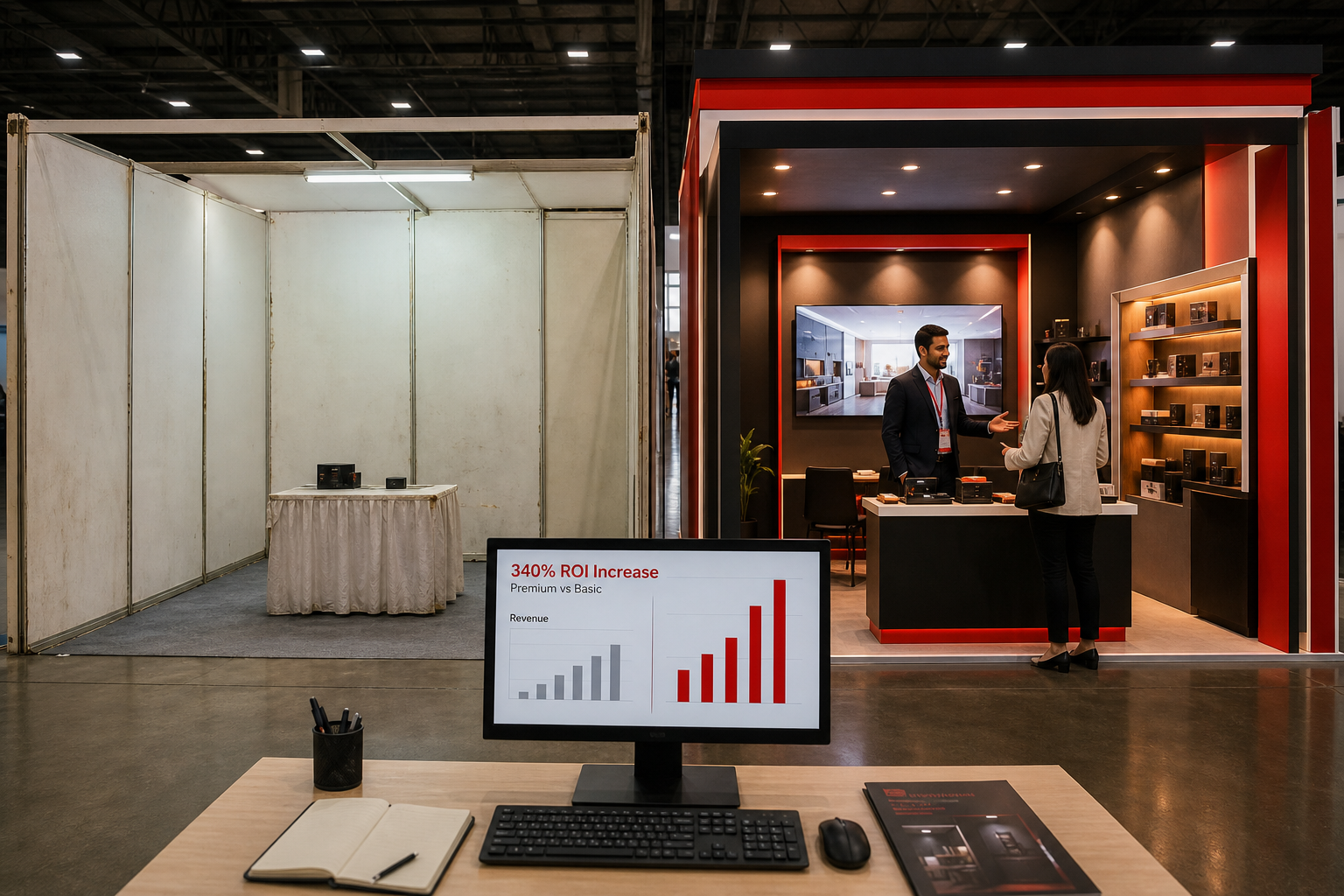
Exhibition ROI is simple arithmetic: revenue from leads and deals, minus total cost of exhibiting, divided by that cost. Your stall affects every variable on the revenue side.
- Attraction rate: the share of passing visitors who stop or glance in.
- Engagement rate: the share of those who start a conversation or interact with a demo.
- Capture rate: the share of conversations that end in a qualified lead.
- Close rate: the share of leads that become customers after the show.
Your floor space, travel and staffing costs stay the same whether your stall performs or not. A stall that lifts attraction and engagement even modestly spreads those fixed costs over more leads, which lowers your cost per lead and raises your return.
That is the core difference between visibility-focused stall design and standard exhibition booth construction. Standard construction asks, “Does it stand up and show our logo?” A visibility-focused build asks, “Can a visitor understand what we do from 10 metres away, and is there a clear reason to step inside?” The first produces a structure. The second produces an exhibition stall design strategy built around traffic flow, sightlines, messaging and conversion.
The Hidden Costs of Poor Stall Design & Layout
How much revenue are you losing with a poorly designed stall? The exact figure depends on your industry and deal size, but you can estimate it with your own numbers. Here is an illustrative example, not a benchmark:
- Your total show cost (space, stall, travel, staff, marketing) is $25,000.
- Your current stall yields 60 qualified leads, and 10% close at an average deal value of $4,000. That is $24,000 in revenue, a net loss of $1,000.
- A better-designed stall lifts qualified leads to 90 at the same close rate. That is $36,000 in revenue and an $11,000 net gain.
In this scenario, the poorly performing stall costs you $12,000 in missed revenue at one show, even though nothing looked “wrong” on the day. Run the same calculation across three or four shows a year and the gap becomes a major budget line.
The hidden costs of poor design usually fall into four groups:
- Lost walk-by traffic: visitors who never register what you sell.
- Wasted staff time: teams who spend hours talking to unqualified visitors because the stall doesn’t filter or guide.
- Lead leakage: conversations that end with no data captured because there’s no easy capture point.
- Brand damage: a cramped, dated or confusing stall signals the same qualities about your product.
Strategic Stall Building Elements That Drive Foot Traffic & Lead Capture
Which stall build features generate the highest ROI? These are the elements that most consistently improve exhibition visibility tactics and lead performance:
1. A single, instantly readable message
Visitors scan aisles quickly. A headline stating what you do and who it’s for, placed at eye level and above the crowd, outperforms a logo wall. Test it by asking a colleague to glance at your design render for three seconds and tell you what you sell.
2. Height and sightlines
Overhead signage, hanging structures and tall back walls make your stall visible from across the hall. Check show regulations first, then design for the angles from which visitors will actually approach: corner stalls, for example, need two strong faces.
3. Open, inviting layout
Walls and counters across the front act as barriers. Open frontage, a clear entry point and a welcoming first interaction zone lower the psychological cost of stepping in.
4. Zoned interior
Separate a demo area, a conversation area and a quiet meeting space. This keeps traffic moving, protects serious conversations and prevents bottlenecks at peak hours.
5. Lighting and focal points
Well-planned lighting draws the eye to your product or demo. A strong focal point, such as a live demonstration, interactive screen or hero product display, gives people a reason to stop.
6. Purpose-built lead capture at expos
Build capture into the structure: badge scanner stations, tablet kiosks, QR codes at natural stopping points, and a clear qualification flow. A stall with no deliberate capture point depends on staff remembering to ask.
7. Smart storage and staff positioning
Hidden storage keeps the floor clear, and a layout that puts staff at the edge of the stall, not behind a counter, makes them approachable.
How Stall Visibility Translates to Lead Quality & Sales Conversion
Visibility is not only about volume. A well-designed stall improves lead quality in three ways.
- Self-qualification: clear messaging means visitors who step in already understand your offer, so conversations start further down the funnel.
- Better conversations: zoned space and uncluttered layout allow longer, more focused discussions with serious buyers.
- Credibility: a professional presence builds trust before anyone speaks. Prospects are more willing to share budget and timeline details with a company that looks established.
How do professional stall builders measure engagement and conversion? Good exhibition stand performance metrics typically include:
- Footfall counts, via manual tallies, sensors or organiser data.
- Stop rate: stops divided by passers-by during sample time windows.
- Dwell time at key zones, such as the demo area.
- Leads captured per staff hour.
- Lead quality scores, using your own sales criteria.
- Cost per qualified lead and post-show pipeline value.
Experienced builders set these targets before the show, track them during it, and use the results to refine the next build. Ask any builder you consider whether they do this.
Is Your Stall Costing You Leads? Get a Clear Answer
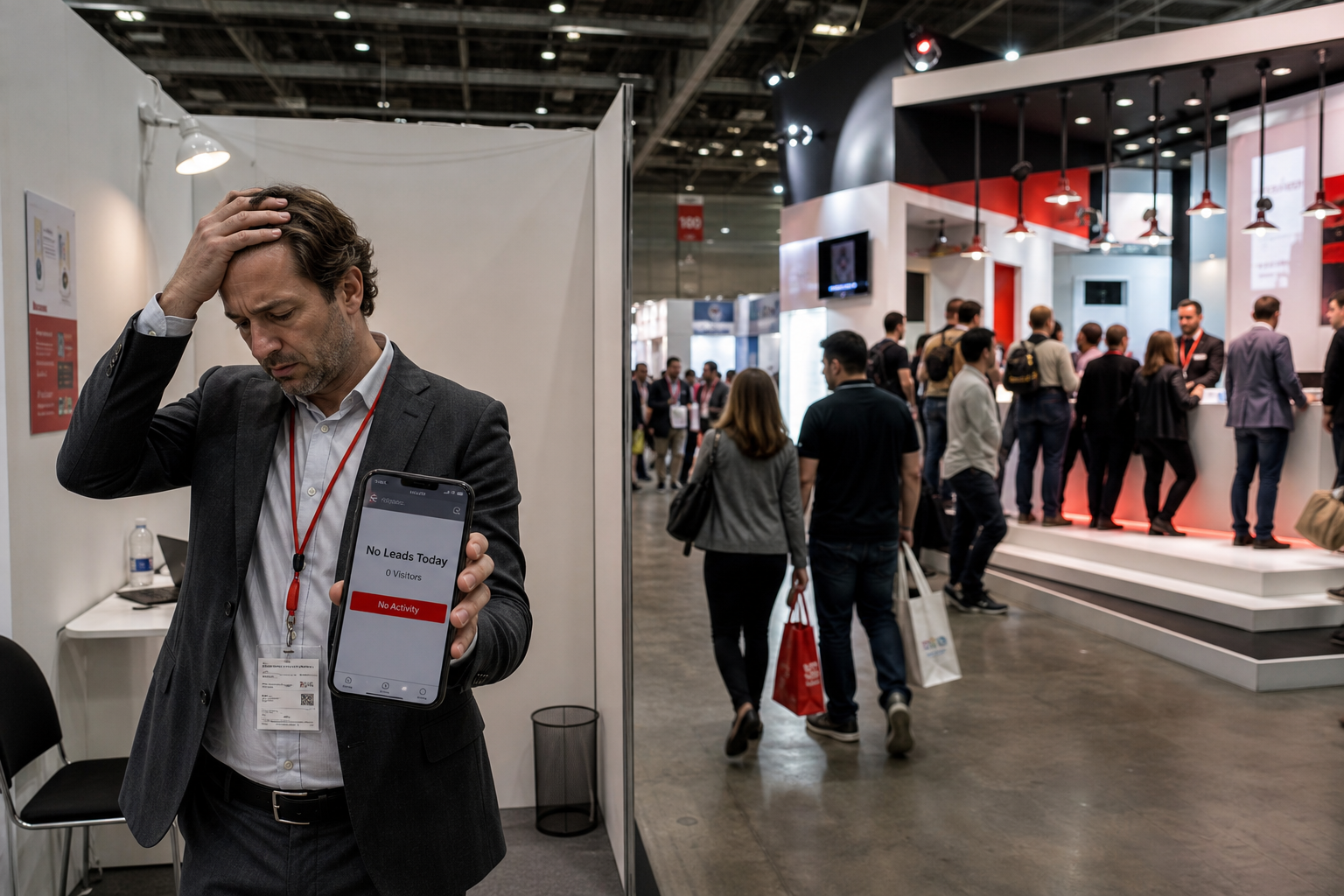
If you exhibit regularly and haven’t measured your stall’s performance against a target, you’re guessing. Our team will review your current setup, your show goals and your numbers, then show you where visibility and conversion are leaking.
Schedule your free exhibition stall strategy session and we’ll calculate your potential ROI and give you a custom build recommendation, with no obligation.
Common Stall Build Mistakes Costing You Exhibition Revenue
- Designing for the brand, not the visitor. Beautiful stalls that don’t explain the offer attract admiration, not enquiries.
- Overcrowding. Too many products, screens and banners dilute the message. One strong idea beats ten competing ones.
- Ignoring traffic flow. Placing a counter or demo where it blocks the entrance creates a barrier.
- Weak or tiny text. If it can’t be read from several metres away, it isn’t working.
- No lead capture plan. Business cards in a bowl are not a system.
- Booking the builder too late. Rushed builds mean compromises on design, materials and logistics, and little time to test.
- Skipping measurement. Without data you repeat the same mistakes at the next show.
- Underbuilding for the space. A small design in a large footprint looks lost; an oversized design in a small one feels cramped.
ROI Comparison: Standard vs. Strategically Built Exhibition Stalls
What’s included in a full stall build service, and how does it compare to DIY or template-based approaches? A full service typically covers strategy and brief, custom design and 3D renders, fabrication, graphics, lighting and AV, logistics, on-site installation and dismantling, plus storage and reuse planning. Template and DIY options usually cover only part of this. The table compares them:
| Factor | DIY / Template Booth | Strategically Built Custom Stall |
|---|---|---|
| Upfront cost | Lowest | Higher |
| Design approach | Generic, fits the space | Built around your goals, audience and floor plan |
| Visibility from the aisle | Often limited to standard shell height and fascia | Planned sightlines, height and messaging |
| Lead capture | Left to staff | Built into layout and workflow |
| Performance tracking | Rarely included | Targets and metrics set and reviewed |
| Setup effort and risk | Your team handles it | Managed end to end by the builder |
| Reusability | Limited and often generic | Modular designs adaptable across shows |
| Typical outcome | Presence | Measurable pipeline |
The honest takeaway: a template booth can make sense for a small, low-stakes show or a first test of a new event. But when shows are a major source of pipeline, the higher upfront cost of a custom build is usually recovered through lower cost per lead and better lead quality. Modular custom builds also spread the cost across multiple events, so the second and third show are cheaper than the first.
Choosing the Right Stall Builder: What to Evaluate Before Your Next Expo
Not every provider of professional booth builder services works the same way. Before you sign, check these points:
- Strategy first: do they ask about your goals, audience and sales process before talking about materials?
- Relevant portfolio: look for work in your industry and at your stall size, and ask for before-and-after results, not only photographs.
- Measurement: will they help set and review performance metrics?
- In-house capability: a builder who designs, fabricates and installs reduces handoff errors and delays.
- Show knowledge: familiarity with venue rules, rigging limits, power and deadlines avoids costly surprises.
- Transparent quotes: itemised pricing covering design, build, transport, installation, dismantling and storage.
- Reuse and flexibility: can the stall adapt to different space sizes and future shows?
- References: speak to recent clients about how the builder handled deadlines and problems.
Also ask what happens if something goes wrong on install day. A confident builder will have a clear on-site support plan.
Getting Started: Book Your Free Stall Design Consultation
Your next expo is already costing you floor space, staff time and travel. The only open question is whether your stall will convert that spend into pipeline.
In your free session, our team will:
- Review your upcoming shows, targets and current stall setup.
- Estimate your potential trade show booth ROI using your own lead and deal numbers.
- Identify the visibility and lead capture gaps most likely to be costing you revenue.
- Give you a custom build recommendation, whether that’s a full custom stall or a lighter upgrade of what you have.
Good stall slots and build timelines fill up as show dates approach, and rushed builds are where quality suffers. Starting early gives you time to design, test and refine.
Schedule your free exhibition stall strategy session with our team today to calculate your potential ROI and get a custom build recommendation.