Implementing augmented reality (AR) and mixed reality (MR) at a Dubai event comes down to six steps: set a measurable goal, choose the right reality layer for your audience, select a tech stack the venue can support, design the interaction around one clear behaviour, test on site, and measure against the original goal. Most projects take 6 to 20 weeks, depending on complexity. This guide walks you through each step, from hardware to budget to the mistakes we see most often, so you can plan an immersive activation with confidence.
What Are AR and Mixed Reality in Events—and Why They Matter for Dubai Brands
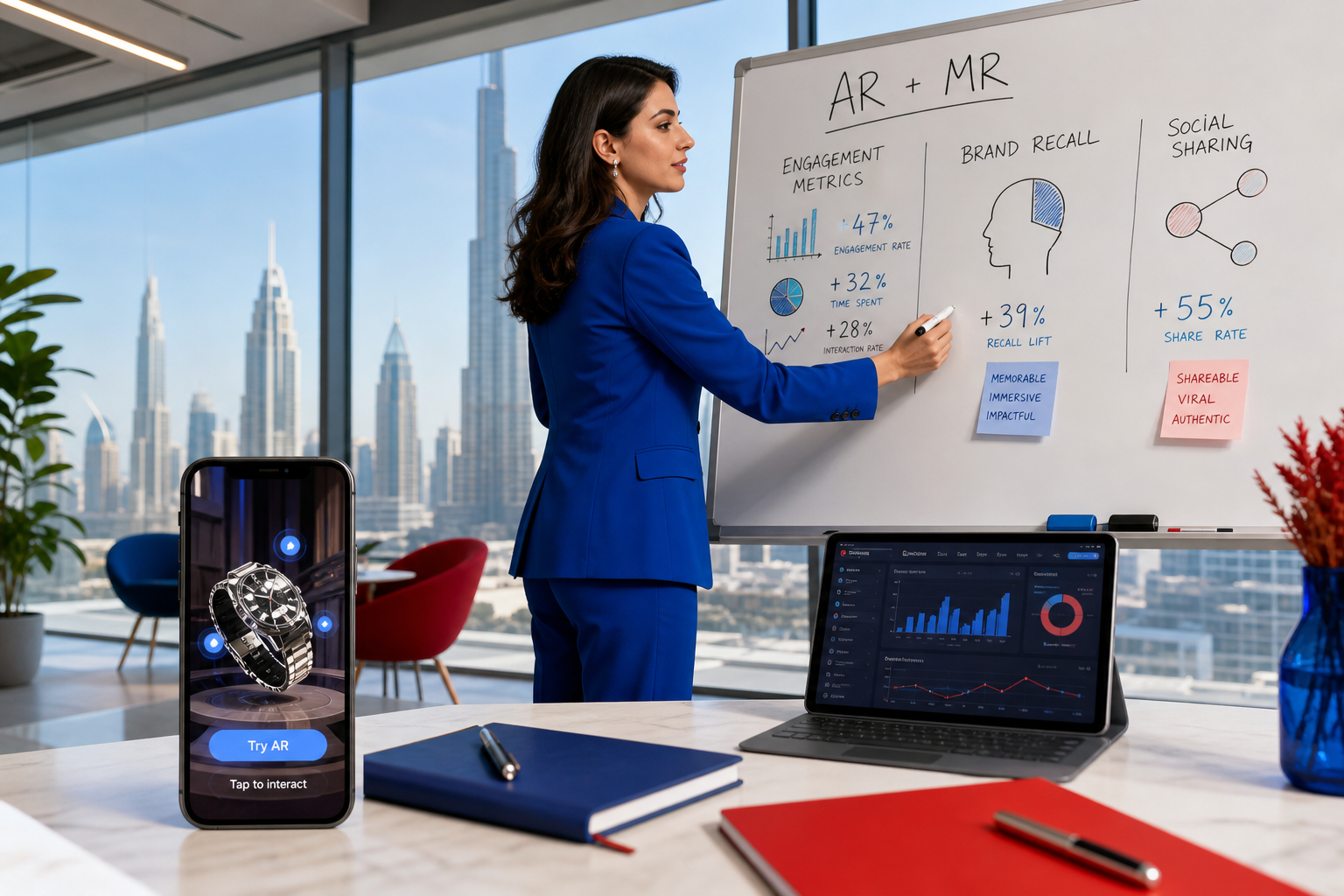
Augmented reality adds digital content, such as 3D models, animations, information, or filters, on top of the real world, usually through a smartphone, tablet, or pair of smart glasses. Mixed reality goes a step further. Digital objects are anchored to the physical space, understand surfaces and depth, and respond to people and their movements, typically through a headset with spatial sensors. Both sit under the wider umbrella of XR (extended reality), alongside virtual reality (VR), which replaces the real world entirely.
What is the difference between AR and mixed reality, and which is better for my event type?
The practical difference is interaction depth and hardware. Use this as a quick guide:
- AR (phone or tablet): Best for large audiences, trade-show floors, public activations, and anywhere you want low friction. Attendees scan a code and begin, with no hardware to hand out.
- AR (smart glasses or large-format screens): Suits guided tours, VIP experiences, and stage moments where a facilitator controls the content.
- Mixed reality (headset): Best for product launches, high-value client demonstrations, and showrooms where a small number of decision-makers should explore a product at full scale.
- VR: Best for transporting people somewhere else entirely, such as a future development, a factory, or a remote location.
For most corporate events in Dubai, the answer is not one or the other. Phone-based AR serves the many, and mixed reality serves the few who matter most. We cover the broader landscape in our overview of AR and VR at events and the future of engagement.
Why do these technologies matter for Dubai brands specifically?
Dubai audiences are digitally fluent, international, and used to high production values. Events here compete with world-class venues, landmark architecture, and a packed calendar of exhibitions and launches. A conventional stage and screen no longer sets a brand apart. Smartphone penetration is very high, mobile networks are strong, and the region’s ambitions around smart-city and digital transformation mean attendees expect technology to be part of the experience. That makes immersive event technology in Dubai less a novelty than a way to show that a brand is serious about innovation.
Used well, AR and MR also solve real event problems. They let you show products that are too large, too early-stage, or too valuable to transport. They make a static booth interactive. They give your team structured data about what attendees actually engaged with, which a brochure never could.
Assessing Your Event Goals: When AR/MR Adds Real Value
The most common error in this field is starting with the technology. A brief that begins “we want an AR experience” usually ends with an expensive novelty. A brief that begins “we need qualified leads who understand our product’s three differentiators” can lead to an AR activation that earns its place.
The 4P Immersion Test
We use a simple framework, the 4P Immersion Test, before recommending any AR or MR layer. If a concept can’t pass all four, we rework it or recommend something simpler.
- Purpose: What single business outcome does this serve, such as leads, product comprehension, dwell time, social reach, or sales conversations?
- Presence: Does the digital layer need to exist in the physical space, or would a video or screen do the job just as well? AR earns its place when scale, context, or spatial relationship matters.
- Participation: Can an attendee do something meaningful within 30 seconds of starting, without instructions from staff?
- Proof: How will we know it worked? Define the metric and the capture method before design begins.
When AR or MR is a strong fit
- Product launches where the product is large, technical, or not yet manufactured.
- Exhibition stands that need to attract and hold attention in a crowded hall.
- Real estate, automotive, and luxury activations where visualising configuration or setting drives decisions.
- Sporting and entertainment events where fans want a layer of stats, replays, or branded interaction.
- Hybrid events where remote participants should feel part of what is happening on site.
When to hold back
If your audience is short on time and moving quickly, such as a networking reception, a headset queue will frustrate people. If the message is simple and emotional, a well-directed live show may do more than any digital overlay. Being honest about this is part of expert event planning. The best immersive work knows where to stop.
The Essential Tech Stack: Hardware, Software, and Platform Choices
Many people ask what hardware and software are needed to deliver an effective AR or MR experience. The answer depends on the experience tier you chose, but the stack always has four layers: delivery devices, content creation, platform and distribution, and infrastructure.
Delivery devices
- Attendees’ own smartphones: The lowest-friction option. Modern iOS and Android devices support AR natively through ARKit and ARCore, and WebAR lets people launch an experience from a QR code in the browser without downloading an app.
- Event-supplied tablets and kiosks: Useful for controlled quality on a booth, with devices pre-loaded and locked to your experience.
- Mixed-reality headsets: Standalone devices such as Meta Quest 3 or Apple Vision Pro offer passthrough video and spatial mapping. They deliver the highest fidelity but require staffing, hygiene protocols, and limited throughput.
- LED walls and projection mapping: Camera-tracked AR on large screens lets a whole audience see the effect at once, which is ideal for stage reveals and mixed reality product launch experiences.
Content creation tools
Real-time engines such as Unity and Unreal Engine power most high-quality AR and MR experiences. Social AR tools like Snap’s Lens Studio suit lightweight, shareable effects. 3D assets typically come from CAD data, photogrammetry, or purpose-built modelling. Optimising these assets matters as much as creating them. A model that looks perfect in the studio can overheat a phone on the show floor.
Platform and distribution
Decide early between a native app, a WebAR experience, or a hybrid. Native apps offer richer performance but require downloads, which in our experience cuts participation sharply on busy event floors. WebAR is faster to adopt and easier to update, though with some limits on graphics and tracking. For most corporate activations, WebAR for the crowd and a native or headset experience for VIPs is the strongest combination.
Infrastructure and data
Connectivity is the quiet failure point. Exhibition halls with thousands of devices can overload public Wi-Fi, so we plan dedicated bandwidth, local content caching, and offline fallbacks. You should also plan lead capture, analytics, and consent handling from the start, so the experience feeds your CRM rather than sitting apart from it. Treat this as the backbone of your event technology implementation strategy.
Budget Planning and ROI: What AR and Mixed Reality Events Actually Cost
The honest answer to “how much does AR or mixed reality cost at a corporate event?” is that scope drives everything. The useful way to approach it is as an investment tied to a measurable outcome, not a line item to minimise. The figures below are indicative planning ranges from our experience of the Dubai market, and a proper scope will refine them.
| Experience tier | Typical format | Indicative range (AED) | Typical lead time |
|---|---|---|---|
| Entry | WebAR effect or product viewer launched by QR code | 25,000–80,000 | 4–6 weeks |
| Mid | Custom interactive AR booth experience with lead capture and analytics | 80,000–250,000 | 8–12 weeks |
| Advanced | Mixed reality headset experience, camera-tracked stage AR, or multi-zone XR activation | 250,000+ | 12–20 weeks |
What drives the cost?
- Content complexity: Number of 3D assets, animation, interaction logic, and bilingual (English and Arabic) content.
- Hardware and staffing: Device rental or purchase, on-site technicians, and hosts to guide attendees.
- Integration: Connecting to registration, CRM, or ticketing systems.
- Physical build: Booth structure, lighting, and sound that make the digital layer work.
- Reusability: Assets built once can be reused across roadshows, showrooms, and future launches, which changes the real cost per use significantly.
How do you measure ROI?
Tie measurement to the “Proof” step of the 4P Test. Useful metrics include:
- Participation rate: the share of visitors who start the experience.
- Completion rate and average dwell time.
- Qualified leads captured and their quality score.
- Social shares and earned media from user-generated content.
- Sales conversations or meetings directly attributed to the activation.
One point most advice misses: the reuse of assets and data is where the return compounds. A 3D product model made for a launch can serve sales teams, e-commerce, and training for years afterwards. That is a genuine part of digital transformation in corporate events, because the event becomes the source of reusable digital assets, not a one-off spend.
Designing Audience Interactions: From Concept to Seamless Execution
Designing interactions that engage attendees and drive business outcomes is where good projects separate from forgettable ones. Audience interaction design for events is different from app or game design, because your user is standing, distracted, often with colleagues, and has perhaps a minute to spare.
Principles that hold up on the show floor
- One idea per experience. Pick the single behaviour you want, such as exploring a product, placing a virtual item, or unlocking a reward, and remove everything else.
- Make the entry obvious. Clear signage, a visible QR code, and a host who demonstrates in ten seconds. Do not assume people will read instructions.
- Design for groups. Many attendees come in pairs or teams. Experiences with a shared screen or a spectator view perform better than solitary ones, and a crowd around a station draws more people in.
- Reward within 30 seconds. Give an early moment of delight, then deepen the experience for those who stay.
- Connect the digital to the physical. The strongest interactive booth design with augmented reality uses the architecture of the stand itself as the trigger or the canvas, so the two layers feel like one.
- Build the data handshake in. Lead capture should feel like part of the experience, such as unlocking a result with a registration, not a separate form.
Designing for Dubai audiences
Dubai events are multilingual and multicultural. Offer English and Arabic as standard, check that imagery and gestures are culturally appropriate, and be mindful of how content appears in right-to-left layouts. For outdoor or atrium activations, plan for glare and heat, which affect screen visibility and device performance. Venues such as exhibition centres and hotels also have their own technical, safety, and approval requirements, which should be confirmed early.
Extending reach beyond the room
Well-designed AR doubles as a virtual event engagement solution. A WebAR product viewer or branded effect can be used by remote audiences too, so the experience reaches people who never enter the venue. This is the idea behind hybrid mixed-reality experiences, where on-site and remote participants share the same digital layer.
From Concept to Execution: A Step-by-Step Implementation Roadmap
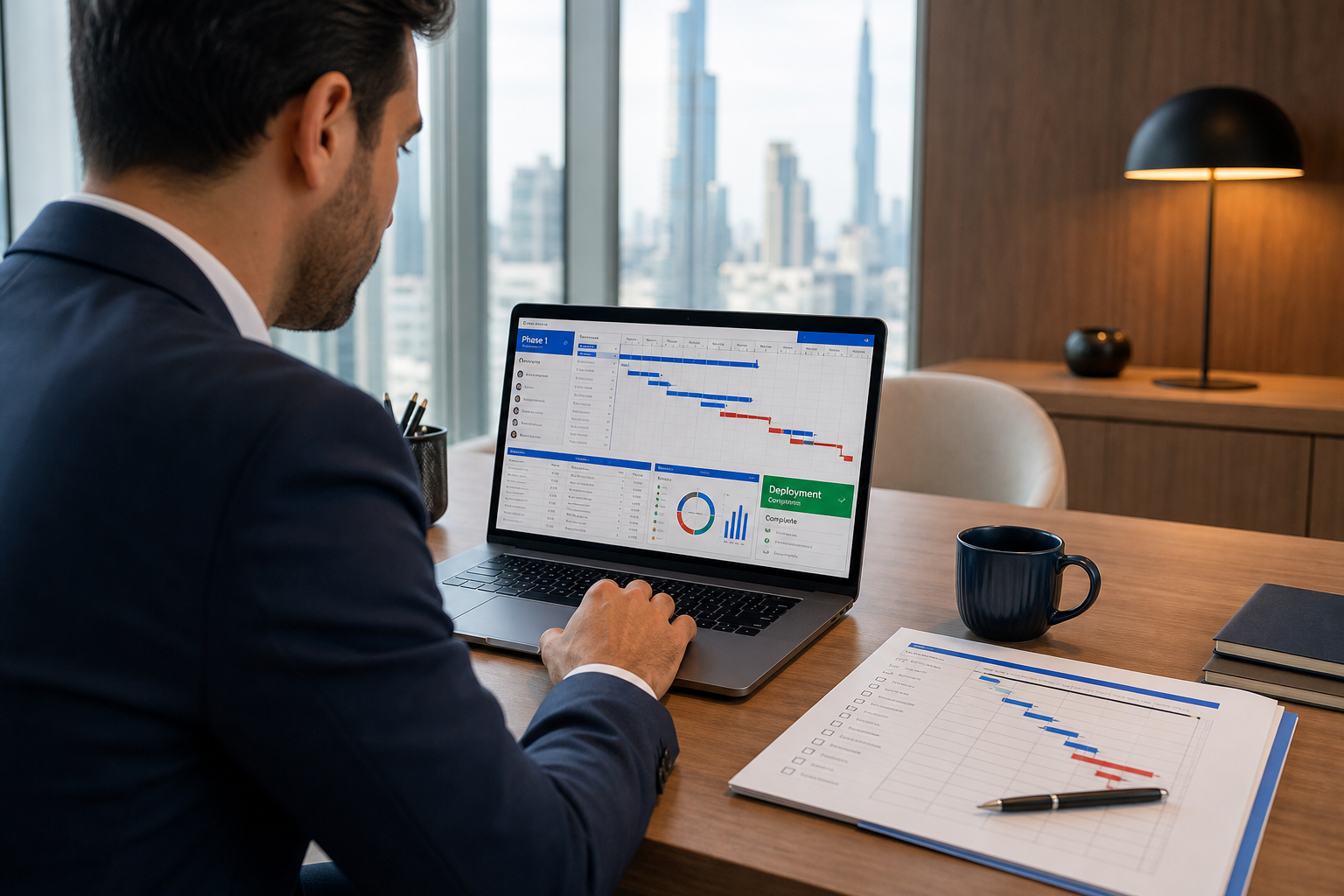
How long does it take to plan and execute an AR or mixed reality event activation? For most projects, between 6 and 20 weeks. Simple WebAR can be delivered in 4 to 6 weeks, while multi-zone XR event activations for corporate clients generally need 12 weeks or more. Here is the roadmap we follow from concept to execution.
Step 1: Discovery and goal setting (weeks 1–2)
Define the audience, the business outcome, the venue, and the metrics. Run the 4P Immersion Test on early ideas. Confirm the event date and work backwards.
Step 2: Concept and experience design (weeks 2–4)
Develop the creative concept, the user journey, and storyboards. Decide the AR/MR tier and the technology approach. Align the digital design with the booth, stage, or venue layout.
Step 3: Technical scoping and venue assessment (weeks 3–5)
Survey the venue for connectivity, power, lighting, and rigging. Confirm device strategy, data and consent requirements, and integration points. Identify risks while they are still cheap to resolve.
Step 4: Asset production and development (weeks 4–10)
Create and optimise 3D assets, build the interaction logic, and develop the front end. Produce bilingual content. Hold review milestones so approvals do not bunch up at the end.
Step 5: Physical build and integration (weeks 6–12)
Fabricate the booth or set, install displays and sensors, and integrate the physical environment with the digital layer. This is where having one team responsible for both design and construction removes handover errors.
Step 6: Testing and rehearsal (final 2–3 weeks)
Test on the actual devices, in realistic lighting, with realistic crowd density. Run a full rehearsal with the hosts and technicians who will operate the experience. Prepare fallbacks, such as a pre-loaded offline mode and spare devices.
Step 7: Live operation and support
Staff the activation with trained hosts and a technician on standby. Monitor live analytics and adjust, for example by moving signage if the participation rate is low.
Celestine Case Studies: Real Results from Dubai Event Activations
We have delivered exhibition booths, live shows, press conferences, fashion events, and brand activations across Dubai, and the lessons below come from that work. Client details are kept confidential, so each example is anonymised. We share project-specific figures and references with prospective clients during consultation.
Exhibition booth: an AR product layer on a physical stand
A technology exhibitor at a major Dubai trade show needed to demonstrate a product too large and complex to bring onto the floor. We designed the booth and the AR layer together. Visitors used tablets mounted at fixed stations to place a full-scale 3D model of the product on a marked area of the floor and explore its components.
- What worked: Fixed, host-supported stations removed the need for visitors to download anything. Queues stayed short because each session had a clear start and end.
- What we measured: Session counts, average interaction time, and the number of qualified leads captured at each station.
- Lesson: The booth layout decided the outcome. Placing the stations where traffic naturally slowed mattered more than any visual effect.
Live show: mixed reality staging for a product reveal
For a corporate launch, we combined a large LED volume with tracked camera content and layered graphics, so the audience in the room and the viewers online saw the same reveal. The sequence was rehearsed against the exact lighting plan and timed to the presenter’s cues.
- What worked: A technician on standby and a pre-rendered fallback for each key moment meant no single failure could stop the show.
- Lesson: Rehearsal with the real presenter and the real lighting caught issues that desk testing never revealed.
Brand activation: guest journeys that people share
For a luxury brand activation, we built a short guided journey in which guests used their own phones to unlock layered content within a physical set. Entry was by QR code, with a bilingual interface and a clear consent step before any data was collected.
- What worked: Designing for a two-minute experience, with one shareable moment at the end, kept participation high and gave the brand organic social reach.
- Lesson: A simple journey, executed precisely, outperforms a complex one that confuses guests.
Common Pitfalls and How to Avoid Them
Most AR and mixed reality problems at events are planning problems rather than technology problems. Most advice focuses on the visual wow factor. In our experience, the failures come from the conditions around the technology. These are the pitfalls we see most often.
Starting with the technology instead of the objective
When the brief begins with “we want AR,” the experience tends to be a novelty with no measurable purpose. Start with the outcome, such as leads, dwell time, or product understanding, and choose the AR or MR tier that serves it.
Testing in the studio but not at the venue
Exhibition halls and outdoor venues in Dubai bring bright lighting, reflective surfaces, crowded wireless networks, and heat. Test on the actual devices, in the real space, at realistic crowd density, and plan for connectivity that may be weaker than expected.
Relying on visitors to download an app
Every extra step reduces participation. Where possible, use browser-based WebAR or provided devices with host support. Reserve app-based experiences for audiences who have a reason to install them in advance.
Treating content as an afterthought
Poorly optimised 3D assets lag, and untranslated interfaces exclude guests. Optimise assets for the target devices and produce English and Arabic content from the beginning.
Separating the physical and digital teams
When one vendor builds the booth and another builds the AR layer, alignment errors appear late and are expensive to fix. A single team accountable for both reduces handover risk and keeps the design coherent.
Ignoring data, consent, and fallback planning
Collecting visitor data without clear consent damages trust, and having no fallback turns a minor fault into a visible failure. Define consent flows early, keep an offline mode, and hold spare devices and a trained technician on site.
Related reading: Why Expo Stall Build Quality Decides Your Visibility, Leads and ROI
Frequently asked questions
How long does it take to implement AR or mixed reality at an event in Dubai?
A typical project runs 10 to 14 weeks from brief to live event, covering strategy, design, technical scoping, production, build, and rehearsal. Simpler WebAR experiences can be delivered faster, while large mixed reality productions need the full timeline.
What is the difference between AR and mixed reality at events?
AR overlays digital content onto the real world, usually through a phone, tablet, or screen. Mixed reality goes further by anchoring digital objects to the physical space so they respond to it, often using headsets, tracking, or LED environments.
Do attendees need to download an app?
Not necessarily. Many experiences run in a mobile browser through a QR code, or on event-provided devices. The best choice depends on the audience and the complexity of the experience.
Can AR and mixed reality work on an exhibition booth?
Yes. Common uses include full-scale product visualisation, interactive demonstrations, and guided stations that capture leads. The booth layout and the digital design should be planned together.
How do you measure the success of an AR or mixed reality activation?
We define metrics at the start, such as participation rate, session length, leads captured, and social shares, and track them live through analytics. This allows adjustments during the event and clear reporting afterwards.
Is AR suitable for sporting events and press conferences?
Yes. At sporting events, it can enhance fan engagement and sponsor visibility. At press conferences, it can support product reveals and data visualisation for both the room and remote audiences.
Plan Your AR and Mixed Reality Activation in Dubai
Successful AR and mixed reality implementation depends on clear objectives, careful venue assessment, tested content, and one team accountable from concept to execution. That approach lets us turn a vision into an experience that guests remember and that your team can measure.
Explore how Celestine Events can transform your next activation with cutting-edge AR and mixed reality—contact our innovation team for a consultation.